OMG, yes! Why didn’t I think of that before!? I’m gonna be a psychology doctor and rename all my hallucinating patients as “Claude” and BAM! They become genius now!
Local models are still controlled by a small group of people, in the sense of deciding how and with what to train the thing. And given the cost of doing so, you can’t just easily fork it and make adjustments yourself.
How about going SETI@home with LLM training? Everyone contributing their own computing power to train better, more transparent local models. Using properly licensed, publically available datasets. Not sure how viable this approach would be, but that would make forking of open-source models possible, maybe?
Olmo exposes all of its training code and training data, including post-training etc.
I’ve trained a tiny GPT model on my computer before. It’s shitty, certainly, very shitty actually, but essentially anyone can train an LLM, if you got either enough time or calculation power.
They are very different, actually. A compiler has a well-defined task: it should take any valid code written in a particular language and generate machine code or intermediate code that does exactly what was instructed in the input code, in accordance to the rules of the language. The exact sequence of opcodes it generates from a given input may not be completely predictable, because there are multiple ways of achieve the same result and different compilers will make different choices in different circumstances, but there should be a clear relationship between the behaviour of the output and the instructions in the input, and if there isn’t, that’s a bug, pure and simple. There’s just not that much room for hijinks, which is why even a proprietary compiler like Visual C++ is more strict about following the standard these days; being the outlier risks irrelevance. But that’s only possible because there’s a clear, shared idea of what a compiler should do.
But with an LLM, the input is any kind of text, and the output is something derived from a large, but finite, fuzzy possibility space, with no understandable relationship between the input and its output. This makes it difficult to reason about failure states. Let’s say there’s a bias in the model that makes it consistently favour using one library over another. Because most people will just take the path of least resistance, that will result in that library becoming more popular at the expense of the other, whose funding may dry up as a result, so this is an issue that affects more than just the users. But what is causing this bias? Is it there intentionally or just a result of the library already being more popular? Is the bias even there to begin with or am I just seeing it because of my own biases? It’s all very hard to say. Just proving that the bias is there and what’s causing it is going to be a lot of effort, as is removing it even with the cooperation of the maintainers. And if they’re not cooperative and I’m on my own without the funding available to them, then forget about it.
Of course, biases don’t just exist in AI models, like how QtCreator is clearly biased towards Qt. But it’s right there on the tin, you knew what you were getting into from the start, and if you don’t like it, there are any number of alternatives. But because of their high cost, there are only so many LLMs of a certain level of capability and they’re all basically immune from accountability, because everything exists in this fuzzy space of reasonable doubt.


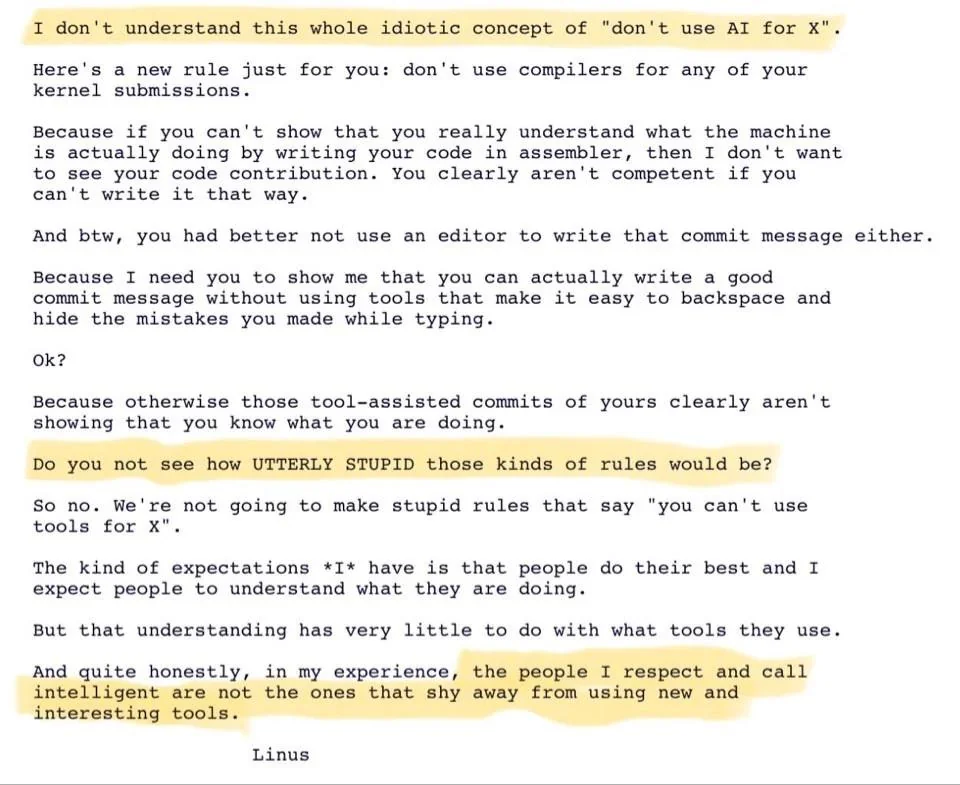
but local models exist, they are a direct threat to anthropic/OpenAi/Xai thats why we must invest our time to make proprietary models irrelevant.
Except Linus is using Claude.
OMG, yes! Why didn’t I think of that before!? I’m gonna be a psychology doctor and rename all my hallucinating patients as “Claude” and BAM! They become genius now!
Local models are still controlled by a small group of people, in the sense of deciding how and with what to train the thing. And given the cost of doing so, you can’t just easily fork it and make adjustments yourself.
How about going SETI@home with LLM training? Everyone contributing their own computing power to train better, more transparent local models. Using properly licensed, publically available datasets. Not sure how viable this approach would be, but that would make forking of open-source models possible, maybe?
Olmo exposes all of its training code and training data, including post-training etc.
Olmo: https://huggingface.co/allenai/Olmo-3-1125-32B
Also Apertus: https://www.apertus-ai.org/
I’ve trained a tiny GPT model on my computer before. It’s shitty, certainly, very shitty actually, but essentially anyone can train an LLM, if you got either enough time or calculation power.
Which is very different from compilers, especially for large languages with existing open source code. Those you just change willy nilly, as you want.
They are very different, actually. A compiler has a well-defined task: it should take any valid code written in a particular language and generate machine code or intermediate code that does exactly what was instructed in the input code, in accordance to the rules of the language. The exact sequence of opcodes it generates from a given input may not be completely predictable, because there are multiple ways of achieve the same result and different compilers will make different choices in different circumstances, but there should be a clear relationship between the behaviour of the output and the instructions in the input, and if there isn’t, that’s a bug, pure and simple. There’s just not that much room for hijinks, which is why even a proprietary compiler like Visual C++ is more strict about following the standard these days; being the outlier risks irrelevance. But that’s only possible because there’s a clear, shared idea of what a compiler should do.
But with an LLM, the input is any kind of text, and the output is something derived from a large, but finite, fuzzy possibility space, with no understandable relationship between the input and its output. This makes it difficult to reason about failure states. Let’s say there’s a bias in the model that makes it consistently favour using one library over another. Because most people will just take the path of least resistance, that will result in that library becoming more popular at the expense of the other, whose funding may dry up as a result, so this is an issue that affects more than just the users. But what is causing this bias? Is it there intentionally or just a result of the library already being more popular? Is the bias even there to begin with or am I just seeing it because of my own biases? It’s all very hard to say. Just proving that the bias is there and what’s causing it is going to be a lot of effort, as is removing it even with the cooperation of the maintainers. And if they’re not cooperative and I’m on my own without the funding available to them, then forget about it.
Of course, biases don’t just exist in AI models, like how QtCreator is clearly biased towards Qt. But it’s right there on the tin, you knew what you were getting into from the start, and if you don’t like it, there are any number of alternatives. But because of their high cost, there are only so many LLMs of a certain level of capability and they’re all basically immune from accountability, because everything exists in this fuzzy space of reasonable doubt.